
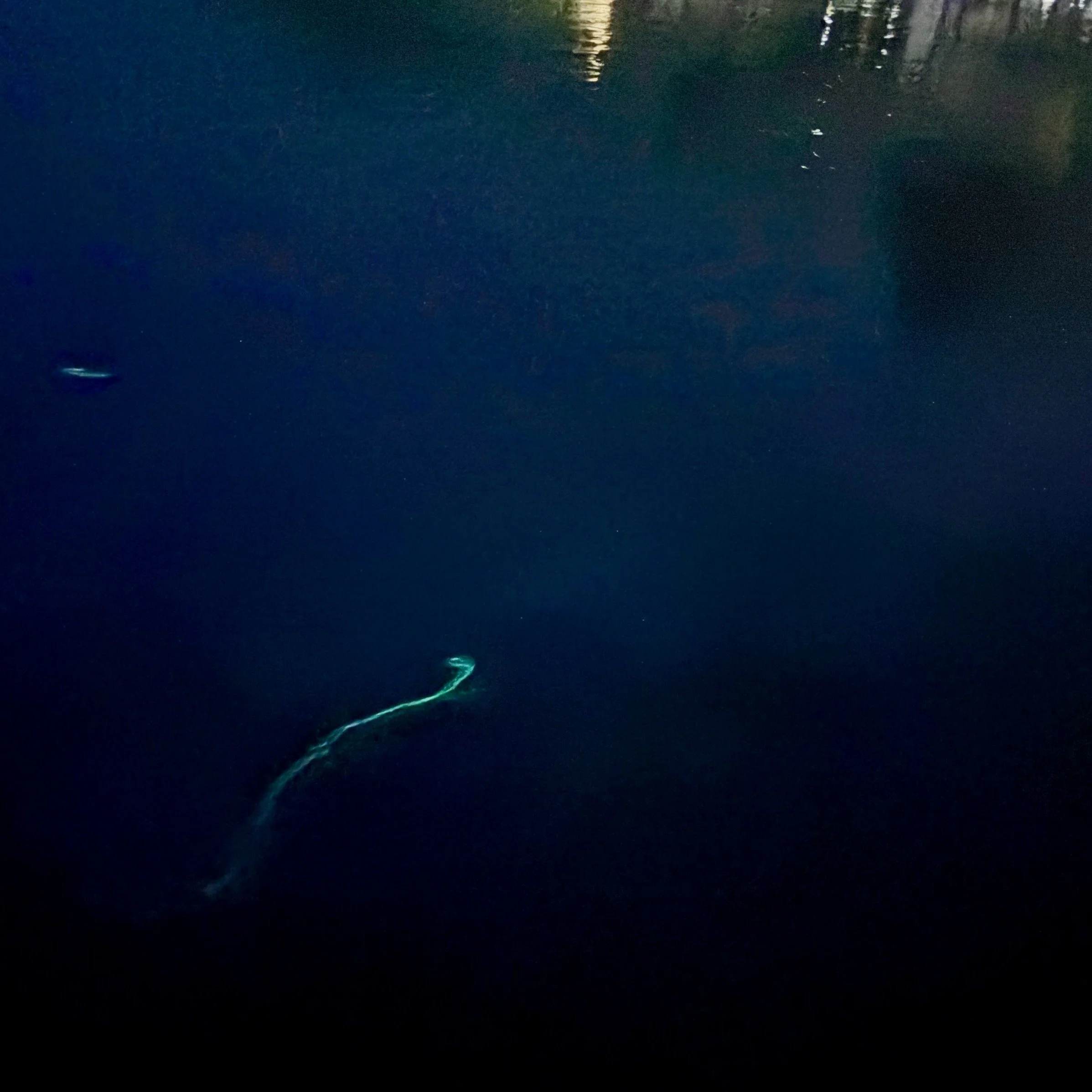
Sea Fireflies at the ipyum main jetty
Sea Fireflies: Tiny Lights in the Waters of Raja Ampat
Nature has a way of surprising us, even in the places we know best. One evening at ipyum, we discovered something extraordinary happening in the water just below our main jetty.
On October 27, 2026, we were enjoring sunset but when we got up to head in for dinner we noticed tiny points of brilliant blue light moving rapidly through the sea beside ipyum's main jetty, on Batanta Island in Raja Ampat's Dampier Strait.
Komaria was afraid these were swimming snakes, but when we turend on our flashlights there was nothing in the water! Very curious.
These weren't ordinary reflections. The lights moved independently, leaving luminous trails behind them. Some travelled in straight lines, while others traced circles and spirals through the darkness.
The effect was rather like watching the contrails of tiny aircraft, except that these trails were underwater, glowing electric blue before gradually fading away.
We had discovered one of the ocean's more remarkable nighttime spectacles: marine bioluminescence.
But what exactly were we looking at?
Meet the Sea Fireflies
One likely explanation is a group of tiny marine animals known as sea fireflies.
Despite their name, sea fireflies aren't insects. They're tiny crustaceans called ostracods, distant relatives of shrimp and crabs. Generally only 1–3 millimetres long, their bodies are enclosed in protective shells resembling miniature seeds.
Certain species possess an extraordinary ability: they produce their own light through a chemical process called bioluminescence.
This phenomenon occurs throughout the marine world, from microscopic plankton to jellyfish, squid, and deep-sea fish. What makes sea fireflies particularly fascinating is their ability to create elaborate patterns of light in the water.
How Does Bioluminescence Work?
Bioluminescence is a chemical reaction that converts energy into visible light while producing very little heat.
In sea fireflies, three ingredients make this possible:
Luciferin: The light-producing chemical.
Luciferase: An enzyme that accelerates the reaction.
Oxygen: Reacts with luciferin to produce light.
The resulting light is typically brilliant blue, a colour that travels particularly well through seawater.
Rather than simply glowing like tiny underwater light bulbs, some sea fireflies release these chemicals directly into the surrounding water as they swim.
The chemicals continue glowing briefly after the animal has moved on, creating luminous trails that gradually fade away.
This could explain the extraordinary blue patterns we observed at ipyum.
Why Do Sea Fireflies Produce Light?
Scientists have identified two important reasons: attracting mates and escaping predators.
During courtship, males of certain species swim through the water while releasing carefully timed flashes of light. These can form distinctive patterns of lines, curves, or spirals, allowing females to recognize potential mates.
Some species even synchronize their displays with neighbouring males, creating coordinated underwater light shows.
The behaviour is remarkably similar to that of terrestrial fireflies, except that these displays take place beneath the sea.
Bioluminescence also provides a defence mechanism. When threatened, sea fireflies can release a cloud of glowing chemicals that startles or distracts predators, giving them an opportunity to escape.
What appears to us as a beautiful natural spectacle may therefore be a sophisticated form of communication—or a clever survival strategy.
What Does the Moon Have to Do With It?
Our discovery occurred just one day after a full Moon, raising an intriguing question: Could the lunar cycle influence these displays?
There are two possible connections.
The first is visibility. Bioluminescence is much easier to observe in darkness. On bright moonlit nights, ambient light can make faint underwater flashes difficult to distinguish. When the Moon is hidden or below the horizon, the same displays can appear dramatically brighter.
The second connection is reproduction. Many marine organisms, including corals, coordinate their reproductive activities with lunar cycles.
Research has shown that moonlight and ambient light can also influence courtship displays in certain bioluminescent sea fireflies.
Interestingly, some bioluminescent marine worms perform circular swimming displays on specific nights following a full Moon. These are another possible explanation for what we observed.
We haven't yet identified the creatures at ipyum with certainty, but the timing of their appearance makes the lunar connection particularly interesting.
Watching for Bioluminescence at ipyum
One of the pleasures of staying somewhere surrounded by nature is discovering how much the environment changes after sunset.
If you're visiting ipyum, keep an eye on the water during the evening, particularly on calm, dark nights.
Look for small streaks of blue light moving independently through the water, about a meter long these glowing trails form lines, circles, or spirals.
If you're fortunate enough to witness a display, observe quietly without shining a flashlight into the water. Artificial light makes bioluminescence harder to see and may interfere with the animals' natural behaviour.
These displays aren't guaranteed, and we're still learning when and why they occur in our waters.
A Little Light in the Darkness
One of the things we love about Raja Ampat is that nature constantly reminds us how much there is still to discover.
The reef fish, corals, mangroves, and tropical birds are immediately obvious. But another world of tiny creatures lives almost entirely unnoticed.
Some are so small that we might never see them at all if they didn't produce their own light.
We don't yet know exactly which species created the glowing trails beside our jetty. But on an otherwise ordinary evening, a few tiny creatures transformed the dark waters of the Dampier Strait into a remarkable natural light show.
Sometimes, the most extraordinary things in nature are also the smallest.
