
Taming the Tide
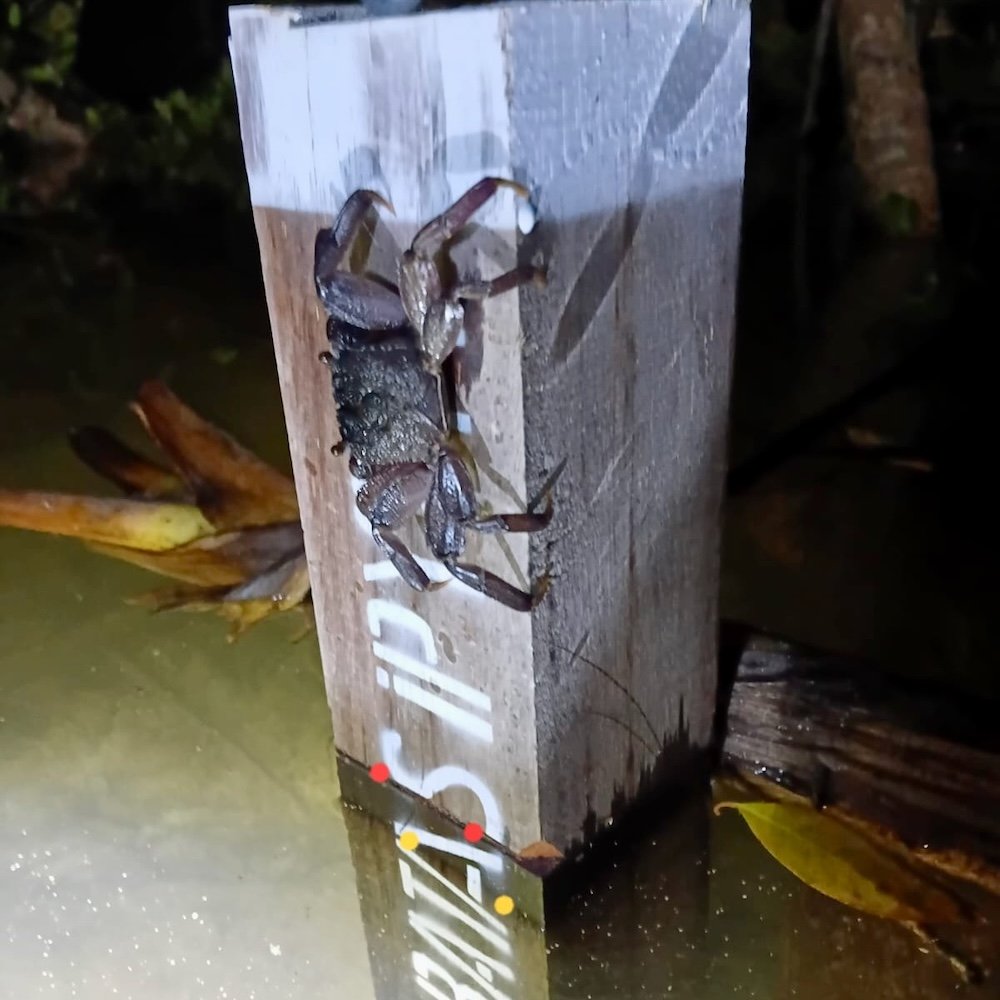
Mangrove crab helping to measure the highest tide of the year.
On December 7 at 7:00 pm, we hit the highest tide of the year. The photo says it all: seawater reached about 50 cm above ground level at our boundary marker. Much of ipyum was underwater.
For ipyum, this isn’t just inconvenient. Regular saltwater flooding:
Disapears our crocs,
Makes daily life inconvenient,
And, most painfully, kills anything we try to grow in the ground.
Half measures won’t work. One flood is enough to kill the entire farm.
That’s why this needs a real solution — not a partial one.
Farming vs. the Tide
Our kitchen garden has been wiped out more times than we care to count. Saltwater is unforgiving. That’s why, today, our vegetables live in what can only be described as inelegant but effective black nursery bags, raised on shelves and posts.
It works — but it’s not the farm we always envisioned.
The Berm Idea (and Why We Changed Course)
At first, the obvious solution seemed to be a berm built with heavy machinery. But machines are expensive, disruptive, and not always realistic in a place like Raja Ampat.
After a lot of thinking (and head‑scratching), we’re convinced the right answer is a low, continuous berm built by hand, using sandbags.
The key insight:
The 50 cm flood is an extreme event.
Most tides only push a few centimetres of water inland.
That means a modest berm, if it’s continuous and well designed, can solve most of the problem.
The Challenge: Scale and Sweat
ipyum is big.
Phase 1 berm: 350–400 m (around our current footprint)
Full build‑out later: ~750 m end‑to‑end
That’s a lot of sand. A lot. Dug, moved, and filled by hand.
Backbreaking work — unless we’re smart about it.
Our DIY Innovation
Instead of stacking endless small sandbags, we’re developing a custom, shaped sandbag system made from heavy geotextile fabric (available in Indonesia).
The idea:
The bag itself matches the final berm shape
Fewer units, better stability
Strong enough to hold heavy sand without slumping
Regular sandbags will still be used underneath to level and prepare the ground, but the main structure will be these long, shaped geotextile berm bags.
Commercial versions exist — and they’re far too expensive.
So, as with much of ipyum, we’ll design and build it ourselves.
Why It’s Worth It
The berm will only be about 50 cm high, but the impact will be huge:
Saltwater flooding will be eliminated
Ground farming finally becomes possible
The mangrove swamp is kept (politely) at bay
This is the difference between improvising forever — and finally building the farm we’ve always planned.
Learning the ipyum Way
We know this won’t be perfect the first time. We’ll learn. We’ll adjust. Hopefully the lessons won’t be too expensive — because I get very crabby when they are.
Still, with a bit of luck, a lot of sweat, and some thoughtful design, we’ll find a way forward.
Next step: prototyping our DIY A‑shape sandbag berm. If it fails, we’ll learn. If it works, we’ll have our tide problem in the bag.
That’s been the ipyum story from day one.
