
Made by ipyum
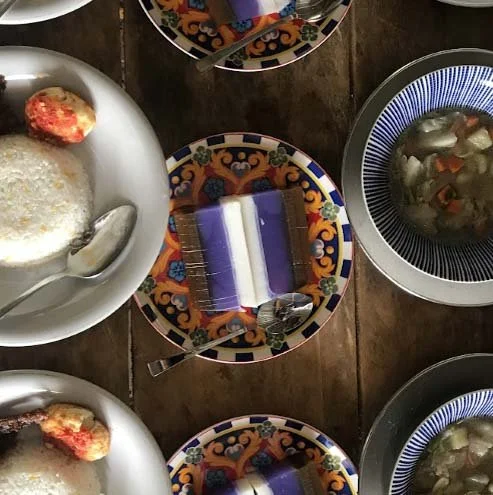
Christina’s tri-colour agar-agar: chocolate, ipyum coconuts, and blue dye extracted from flowers growing in our garden.
At ipyum, you first notice bird calls, breezes, water, trees, natural buildings, and our garden. What you don’t immediately see is the movement behind the scenes.
ipyum is a place where things are constantly being made.
Not just food—but furniture, buildings, tools, and systems. It is less like a hotel under construction and more like a beehive, humming productively and quietly from morning until night. Where co-owner Komaria is definitely the queen bee :-)
From scratch, by default
In the kitchen, almost everything starts from raw ingredients. We don’t buy shortcuts. We experiment, adjust, fail, and try again.
Christina’s agar-agar in the photo is a good example. Chocolate, coconut, and a blue colour extracted from flowers growing in our garden. Simple ingredients, layered carefully and patiently. Maria's donuts are likewise the product of a lot of experimentation and experience.
That approach runs through everything we do.
Beds, sofas, chairs, and tables—made here from local materials with local skills. Mosquito nets and curtains—cut, sewn, and adjusted in East Java by Komaria’s lifelong neighbours. Concrete junction boxes designed at ipyum—cast by hand at ipyum. Our solar canopies—radically different, made possible by custom-designed mounting brackets. Buildings—designed to be well built using low-tech methods and local materials.
A hive of makers
On any given day, someone is measuring, cutting, sewing, mixing, testing, or prototyping. What works gets captured—through simple designs and lots of photos—moving steadily from one mistake to the next improvement.
Some days the results are beautiful. Some days they are merely functional. Occasionally, they fail completely.
That’s how we are creating ipyum.
Plan, then act
Most designs begin as sketches and measurements. The broad strokes usually come from me, but the details of how something is actually made are developed by the people building it. Half-formed ideas only become real once many other hands get involved.
In the kitchen, Komaria plays the same role. She designs, tests, and refines. The dishes that come out of the kitchen are not just cooked—they are developed, then documented.
Different domains, same mindset.
Why we choose this path
Making things ourselves is slower, messier, and demands patience and humility.
But it gives us something we couldn’t buy: understanding—and something uniquely ipyum. Buying products from factories, shipping them here, and maintaining them is impractical for many reasons, not only financial.
Because we make things ourselves, we know how they are put together. We know how to fix them. We know how to improve them next time. Most importantly, we build skills and confidence within the team, rather than dependency on distant suppliers.
ipyum is still a work in progress. Much of it always will be.
But piece by piece, meal by meal, chair by chair, it is becoming something deeply its own—made, quite literally, by ipyum.
The word ipyum means good and beautiful, but with an important nuance: it also implies becoming better. We do this for many reasons. We can’t afford the level of quality we want if we simply buy it. More importantly, it often doesn’t make sense to buy something when we can make it ourselves and create work for local people.
Choosing between giving work to a distant factory or to a local craftsperson is easy. With the right approach—and without lowering standards—a low-tech path can deliver much of what we need while avoiding unnecessary industrial products and critically, local environmental impact.
We hope our guests will appreciate our conscious effort to de-industrialise in a rational way—something quietly beautiful to sit alongside the bird calls and breezes at ipyum.
