
Lili’s Learning Journey
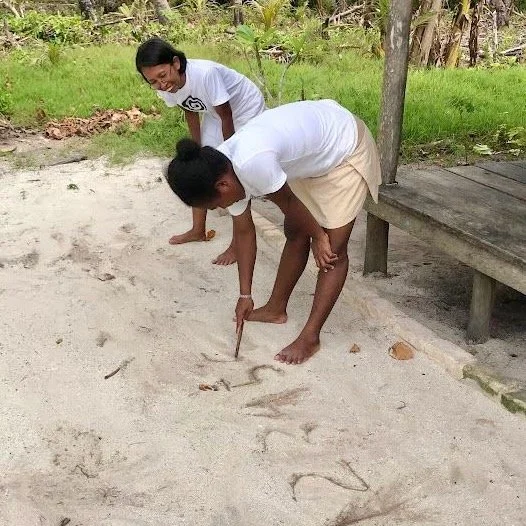
Lili starting to learn numbers, while on lunch break
Lili is the newest member of our team at ipyum. She is 24 years old, born and raised in a nearby village. Most of her life has been spent helping her family. She has never been to school, and she cannot use letters or numbers.
One of our team members proposed Lili as a new staff member and vouched for her ability to do the job. We agreed to give her a chance.
ipyum is different from most businesses in this region. We expect our staff to operate much like employees in Europe or other developed countries. That means clear processes, shared responsibility, and—crucially—communication through mobile phones and WhatsApp.
ipyum is already a fairly digitised operation, and it will become even more so over time. For that reason, basic literacy and numeracy are not optional. They are essential.
Lili is not the first person we’ve hired who struggles with reading and math, but she is the most challenged so far. Shortly after she joined, it became clear that her continued employment would depend on her ability to learn both.
Learning Without a Classroom
Lili works with Team Yummy, and Christina, the team lead, took on the responsibility of guiding her into the world of letters and numbers.
There is no classroom.
Lessons happen on the beach, in the kitchen, wherever work is being done. Numbers are learned by counting plates before service, by measuring rice and spices, by dividing portions. Letters are traced with sticks in the sand, erased by the tide, then written again. Learning happens in short bursts, improvised and practical, woven into the rhythm of daily work.
In many ways, this is education as it existed long before schools—learning by doing, learning through repetition, learning with purpose.
It feels appropriate. The villages around ipyum live a quasi-modern life: smartphones and WhatsApp exist alongside pre-industrial ways of living. Technology arrives faster than education ever did.
A Curious Paradox
What’s striking is that Lili can already use a smartphone. She posts WhatsApp status updates, navigates icons, shares photos—yet she cannot read the words on the screen. It’s possible she may have dyslexia, though we don’t know yet. What we do know is that she is trying.
Komaria, ipyum’s co-owner, has experience teaching adults how to read and is helping guide the process. It’s still early days, but there are small signs of progress—and real determination.
Beyond Lili
Lili’s story is not unique. Many people in this region leave school after a year or two, if they attend at all. Corruption, weak institutions, and lack of access have left deep gaps in education.
One of our team leads—head of Team Cassowary—also struggles with basic literacy. Yet he consistently delivers exceptional value in a complex, demanding operation. Watching this, it’s hard not to wonder what might be possible if talent like his had been paired with a solid education.
Looking Ahead
Komaria and I often talk about the future. Once ipyum is built—or at least stable—we are considering how we might support education more formally. A school, a learning center, or something we haven’t imagined yet. For now, that remains a question for another chapter.
In the meantime, we do what we can.
If, along the way to building ipyum, we can help open the door to reading and mathematics for some of our team, that will be an outcome we’re deeply proud of—not just for the business, but for the people who are building it with us.
For both Lili and ipyum, learning begins where we stand - on the beach, focusing on the basics, making things work and learing as we go.
